Free discovery call with our principal designer.
✕
Free discovery call with our principal designer.
✕

Layered Bedroom Lighting: Calm at Night, Bright When You Need It
A designer's guide to bedroom lighting layers: ambient, reading, closet and night path light, warm color temperatures and controls you can reach from bed.
A designer's guide to bedroom lighting layers: ambient, reading, closet and night path light, warm color temperatures and controls you can reach from bed.
A designer's guide to bedroom lighting layers: ambient, reading, closet and night path light, warm color temperatures and controls you can reach from bed.
M.V
Marian Vist · Principal designer
·
·
5 min read
Take this into your home
Bring this article into your first conversation.
Share the passage and explain how it relates to the home you are planning.
01
01
How to Light a Bedroom Well
A well-lit bedroom has four layers: soft ambient light, focused reading light at the bed, accurate light where you dress, and a very low path light for the night. Each layer has its own control, dims smoothly and stays warm, so the room is calm at night and practical in the morning. The common mistake is relying on a grid of recessed downlights. In a bedroom you spend much of your time lying down and looking up, so ceiling fixtures directly over the bed shine into your eyes. Downlights also light the floor more than faces and walls, which makes a room feel flat. Good bedroom lighting starts from the bed, the dressing area and the routes between them. Where will you read? Where do you choose clothes? Which way do you walk to the bathroom at 3 a.m.? Does a partner sleep while you read? The answers define the fixtures, and the controls follow. Color temperature ties the layers together. In bedrooms we typically stay between 2200 and 2700K, and we favor dim-to-warm fixtures that turn more amber as they dim, much as incandescent bulbs once did. The effect at low levels is closer to candlelight than to an office.
A well-lit bedroom has four layers: soft ambient light, focused reading light at the bed, accurate light where you dress, and a very low path light for the night. Each layer has its own control, dims smoothly and stays warm, so the room is calm at night and practical in the morning. The common mistake is relying on a grid of recessed downlights. In a bedroom you spend much of your time lying down and looking up, so ceiling fixtures directly over the bed shine into your eyes. Downlights also light the floor more than faces and walls, which makes a room feel flat. Good bedroom lighting starts from the bed, the dressing area and the routes between them. Where will you read? Where do you choose clothes? Which way do you walk to the bathroom at 3 a.m.? Does a partner sleep while you read? The answers define the fixtures, and the controls follow. Color temperature ties the layers together. In bedrooms we typically stay between 2200 and 2700K, and we favor dim-to-warm fixtures that turn more amber as they dim, much as incandescent bulbs once did. The effect at low levels is closer to candlelight than to an office.
02
02
Ambient Light Without Glare
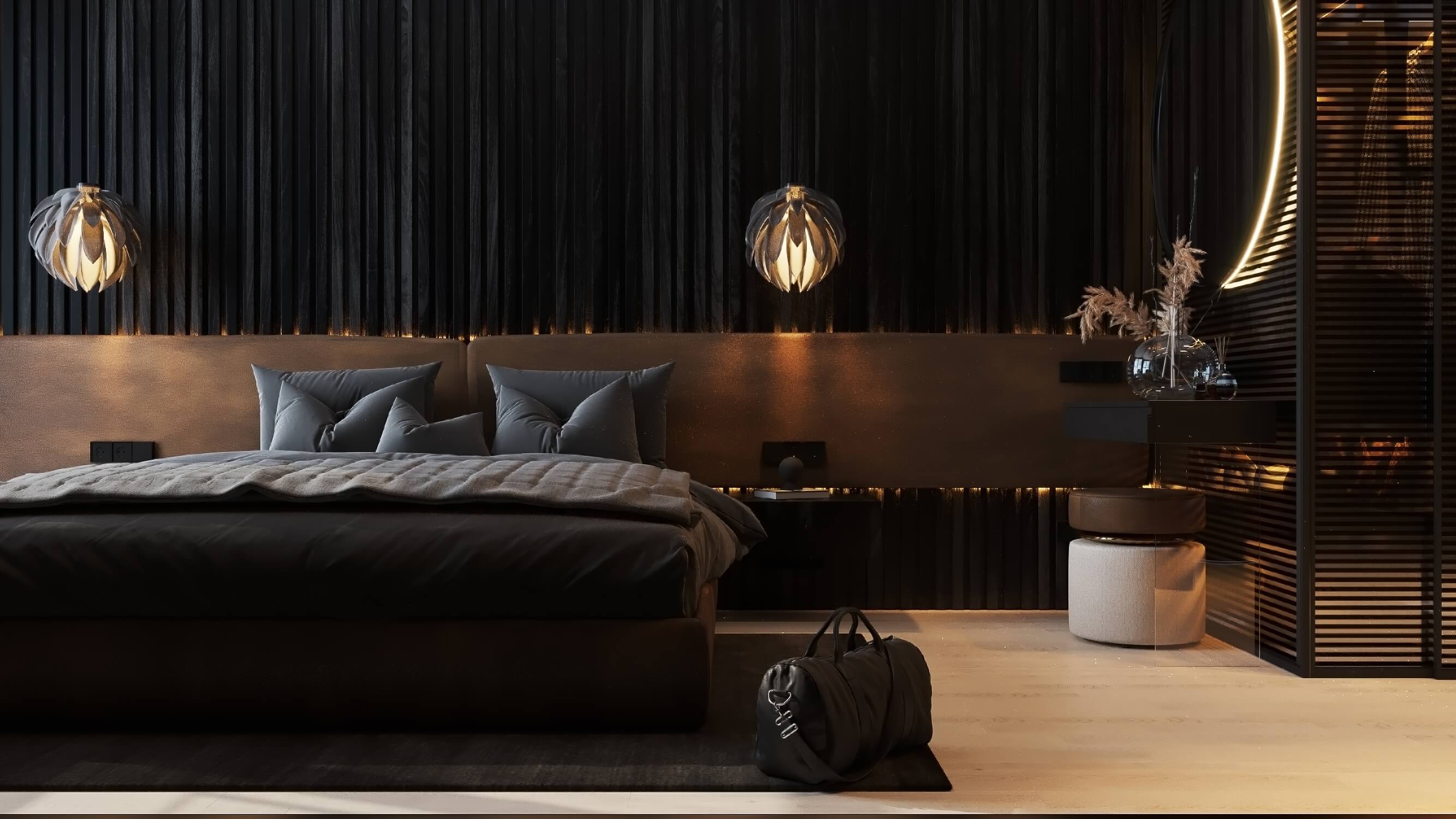
Ambient light should fill the room without drawing attention to its source. Several approaches work, often in combination. A cove at the ceiling perimeter bounces light off the ceiling for a soft, even glow. Wall washers or adjustable recessed fixtures placed near the walls light vertical surfaces, art and curtains, which makes a room feel larger and calmer than lighting the middle of the floor. A pendant or ceiling fixture gives character and is fine if it is diffused and dimmable. Keep recessed fixtures away from the zone above the bed and out of the sightline when you look up from the pillow. Deeply recessed or trimless fixtures with a sharp cutoff angle reduce glare from anywhere in the room. Specify a CRI of 90 or higher so wood, textiles and skin look natural, and check that fixtures dim smoothly to very low levels without flicker. Compatibility between LED fixtures, drivers and dimmers matters, because mismatched components cause buzzing and flicker that are especially unwelcome at night. Table and floor lamps belong in the ambient layer too. Placed on circuits switched from the entrance, they give a warm, residential quality that no ceiling fixture can match, and they bring light down to eye level where conversation and reading happen.
Ambient light should fill the room without drawing attention to its source. Several approaches work, often in combination. A cove at the ceiling perimeter bounces light off the ceiling for a soft, even glow. Wall washers or adjustable recessed fixtures placed near the walls light vertical surfaces, art and curtains, which makes a room feel larger and calmer than lighting the middle of the floor. A pendant or ceiling fixture gives character and is fine if it is diffused and dimmable. Keep recessed fixtures away from the zone above the bed and out of the sightline when you look up from the pillow. Deeply recessed or trimless fixtures with a sharp cutoff angle reduce glare from anywhere in the room. Specify a CRI of 90 or higher so wood, textiles and skin look natural, and check that fixtures dim smoothly to very low levels without flicker. Compatibility between LED fixtures, drivers and dimmers matters, because mismatched components cause buzzing and flicker that are especially unwelcome at night. Table and floor lamps belong in the ambient layer too. Placed on circuits switched from the entrance, they give a warm, residential quality that no ceiling fixture can match, and they bring light down to eye level where conversation and reading happen.
03
03
Reading Light That Respects a Partner
Reading light should land on the page, not on the pillow beside you. Wall-mounted adjustable sconces or articulated reading lights with a narrow beam work well, especially when two people share the bed. Mounted at the right height, typically so the light source sits a little above shoulder level when you sit against the headboard, they direct light down and forward without glare. Bedside table lamps can serve for reading if the shade is opaque or lined, so light goes down rather than sideways. A lamp with a translucent shade glows across the room, which suits the ambient layer more than reading. Reading lights integrated into an upholstered or paneled headboard are another option, provided the drivers remain accessible for servicing. We plan the headboard and the electrical layout together, so wiring, switches and USB-C charging points sit exactly where hands reach for them. For reading, a color temperature of about 2700 to 3000K is comfortable, slightly crisper than the ambient layer. Each side of the bed should control its own reading light independently, so one person can switch off and sleep without affecting the other, and the reader is never tempted to use the overhead lights instead.
Reading light should land on the page, not on the pillow beside you. Wall-mounted adjustable sconces or articulated reading lights with a narrow beam work well, especially when two people share the bed. Mounted at the right height, typically so the light source sits a little above shoulder level when you sit against the headboard, they direct light down and forward without glare. Bedside table lamps can serve for reading if the shade is opaque or lined, so light goes down rather than sideways. A lamp with a translucent shade glows across the room, which suits the ambient layer more than reading. Reading lights integrated into an upholstered or paneled headboard are another option, provided the drivers remain accessible for servicing. We plan the headboard and the electrical layout together, so wiring, switches and USB-C charging points sit exactly where hands reach for them. For reading, a color temperature of about 2700 to 3000K is comfortable, slightly crisper than the ambient layer. Each side of the bed should control its own reading light independently, so one person can switch off and sleep without affecting the other, and the reader is never tempted to use the overhead lights instead.
04
04
Closet, Dressing and Night Path Lighting
In the closet and dressing area, accuracy matters more than mood. You need to tell navy from black and see the true color of fabric, so we use a CRI of 90 or higher, often at 3000K, slightly whiter than the bedroom while still warm. Vertical light works well here: LED strips integrated into the front edge of shelves or along the sides of wardrobe openings light clothes from the front, and lit rods illuminate hanging garments. Door-activated switches in wardrobes are simple and effective. The mirror needs light on the face from the front or sides, the same principle used at a bathroom vanity. Night path lighting is the most underrated layer. Low-level lights at toe-kick height, under the bed frame or along the route to the bathroom, triggered by motion sensors, let you walk without waking fully or disturbing anyone. Keep them very dim and warm, around 1800 to 2200K, and aimed at the floor. A matching low glow in the bathroom lets you get there and back without switching on any overhead light, which protects both your sleep and a partner's.
In the closet and dressing area, accuracy matters more than mood. You need to tell navy from black and see the true color of fabric, so we use a CRI of 90 or higher, often at 3000K, slightly whiter than the bedroom while still warm. Vertical light works well here: LED strips integrated into the front edge of shelves or along the sides of wardrobe openings light clothes from the front, and lit rods illuminate hanging garments. Door-activated switches in wardrobes are simple and effective. The mirror needs light on the face from the front or sides, the same principle used at a bathroom vanity. Night path lighting is the most underrated layer. Low-level lights at toe-kick height, under the bed frame or along the route to the bathroom, triggered by motion sensors, let you walk without waking fully or disturbing anyone. Keep them very dim and warm, around 1800 to 2200K, and aimed at the floor. A matching low glow in the bathroom lets you get there and back without switching on any overhead light, which protects both your sleep and a partner's.
05
05
Controls Within Reach of the Bed
Controls make or break a bedroom lighting plan. At a minimum, you should be able to turn off every light in the room from the bed without getting up. Three-way switching, with a switch at the entrance and another at the bed, is the simplest version. A keypad on each side of the bed with a few named scenes, such as Reading, Relax, Night and All Off, is a more complete one. Program scenes rather than individual fixtures. A morning scene might bring the cove and wall lights up gradually; an evening scene sets lamps and cove low and warm; a night scene turns everything off except the path lighting. Keep keypads simple and engraved. Backlit buttons should be dim enough not to glow in the dark. If the house has a lighting control system, link the bedroom shades to the same keypad so one button can close the shades and dim the lights together. In homes with integrated technology, such as the Layered Contrasts Residence in New York, a smart luxury family home where classical paneling meets integrated systems, the same thinking applies: controls should feel intuitive to guests and children, not only to the person who programmed them.
Controls make or break a bedroom lighting plan. At a minimum, you should be able to turn off every light in the room from the bed without getting up. Three-way switching, with a switch at the entrance and another at the bed, is the simplest version. A keypad on each side of the bed with a few named scenes, such as Reading, Relax, Night and All Off, is a more complete one. Program scenes rather than individual fixtures. A morning scene might bring the cove and wall lights up gradually; an evening scene sets lamps and cove low and warm; a night scene turns everything off except the path lighting. Keep keypads simple and engraved. Backlit buttons should be dim enough not to glow in the dark. If the house has a lighting control system, link the bedroom shades to the same keypad so one button can close the shades and dim the lights together. In homes with integrated technology, such as the Layered Contrasts Residence in New York, a smart luxury family home where classical paneling meets integrated systems, the same thinking applies: controls should feel intuitive to guests and children, not only to the person who programmed them.
06
06
How We Plan Bedroom Lighting
At ImPERFECTION DESIGN, lighting is drawn alongside the furniture plan rather than added afterward. Fixture positions, switch and keypad locations, and lighting integrated into millwork are fixed on plans and elevations, and every room is rendered in photorealistic 3D so you can judge the atmosphere before anything is wired. We also mark which fixtures belong to which scene, so the electrician, the integrator and you are reading the same plan. We coordinate with the electrician and any lighting control integrator, and fixtures are purchased at cost with 0% markup through our network of 150+ suppliers and workrooms. Once the rooms are installed, scenes often need refinement after a few weeks of living with them, which is part of the 12 months of adjustments and support the boutique studio provides after handover. The goal is a room you stop noticing at night, because every light is where your hand expects to find it and every scene does what its name says.
At ImPERFECTION DESIGN, lighting is drawn alongside the furniture plan rather than added afterward. Fixture positions, switch and keypad locations, and lighting integrated into millwork are fixed on plans and elevations, and every room is rendered in photorealistic 3D so you can judge the atmosphere before anything is wired. We also mark which fixtures belong to which scene, so the electrician, the integrator and you are reading the same plan. We coordinate with the electrician and any lighting control integrator, and fixtures are purchased at cost with 0% markup through our network of 150+ suppliers and workrooms. Once the rooms are installed, scenes often need refinement after a few weeks of living with them, which is part of the 12 months of adjustments and support the boutique studio provides after handover. The goal is a room you stop noticing at night, because every light is where your hand expects to find it and every scene does what its name says.
Questions
What color temperature is right for a bedroom?
–
Warm light suits bedrooms. Designers commonly specify 2200 to 2700K for ambient and lamp light, and around 2700 to 3000K for reading and dressing. Dim-to-warm fixtures that shift toward amber as they dim are especially pleasant at night. Choose fixtures with a CRI of 90 or higher so skin, wood and fabric look natural.
Should I put recessed lights over the bed?
+
It is better to avoid them. When you lie in bed you look up, so downlights directly overhead shine into your eyes. Place recessed fixtures near the walls to light surfaces, art and curtains instead, and rely on wall sconces, lamps and indirect cove lighting for the area around the bed.
What is night path lighting?
+
Night path lighting is very low, warm light near the floor, often in toe kicks, under the bed or along the route to the bathroom. Usually triggered by motion sensors, it lets you move safely at night without turning on main lights or fully waking up. It works well at around 1800 to 2200K, aimed downward.
How high should bedside reading sconces be mounted?
+
Mount reading sconces so the light source sits slightly above shoulder height when you sit up in bed, which often places it roughly 20 to 30 inches above the mattress surface, depending on headboard height and posture. Adjustable arms and narrow beams let each person direct light onto the page without disturbing a partner.
M.V
Marian Vist
Principal designer, ImPERFECTION DESIGN. Creates the design concept and leads the decisions that shape each home. New York · New Jersey · Florida · International.
Meet Marian
Continue reading
All articles

Take the idea into your own home.
Tell us which subject connects with your plans and the decision you would like to explore.
Tell us which subject connects with your plans and the decision you would like to explore.