Free discovery call with our principal designer.
✕
Free discovery call with our principal designer.
✕

Bathroom Lighting Design: Layers That Flatter and Work
How to light a bathroom well: vanity light at face height, ambient and accent layers, color temperature and CRI, wet-location ratings and night light.
How to light a bathroom well: vanity light at face height, ambient and accent layers, color temperature and CRI, wet-location ratings and night light.
How to light a bathroom well: vanity light at face height, ambient and accent layers, color temperature and CRI, wet-location ratings and night light.
M.V
Marian Vist · Principal designer
·
·
5 min read
Take this into your home
Bring this article into your first conversation.
Share the passage and explain how it relates to the home you are planning.
01
01
The short answer: light the face, then the room
Good bathroom lighting starts at the mirror. Place light at face height on both sides of the vanity so it falls evenly across the face, then add soft ambient light for the room, a few accents for atmosphere and a low night light. Keep color warm, color rendering high and every circuit dimmable. Most disappointing bathrooms are lit from directly above. A row of recessed downlights over the vanity is easy to install, and it casts shadows under the eyes, nose and chin that make everyone look tired. It also creates glare on polished stone and leaves the mirror itself dim. The fix is not more light but better placed light. A bathroom asks lighting to do several jobs in one small room. In the morning it has to support shaving, makeup and contact lenses with accuracy. In the evening it should help the body wind down before sleep. In the middle of the night it should allow a safe walk without fully waking anyone. Treating these as separate layers, each with its own fixtures and controls, is what lets one room handle all three without compromise, and it is a standard approach in well-designed residential and hospitality bathrooms.
Good bathroom lighting starts at the mirror. Place light at face height on both sides of the vanity so it falls evenly across the face, then add soft ambient light for the room, a few accents for atmosphere and a low night light. Keep color warm, color rendering high and every circuit dimmable. Most disappointing bathrooms are lit from directly above. A row of recessed downlights over the vanity is easy to install, and it casts shadows under the eyes, nose and chin that make everyone look tired. It also creates glare on polished stone and leaves the mirror itself dim. The fix is not more light but better placed light. A bathroom asks lighting to do several jobs in one small room. In the morning it has to support shaving, makeup and contact lenses with accuracy. In the evening it should help the body wind down before sleep. In the middle of the night it should allow a safe walk without fully waking anyone. Treating these as separate layers, each with its own fixtures and controls, is what lets one room handle all three without compromise, and it is a standard approach in well-designed residential and hospitality bathrooms.
02
02
Vanity lighting at face height
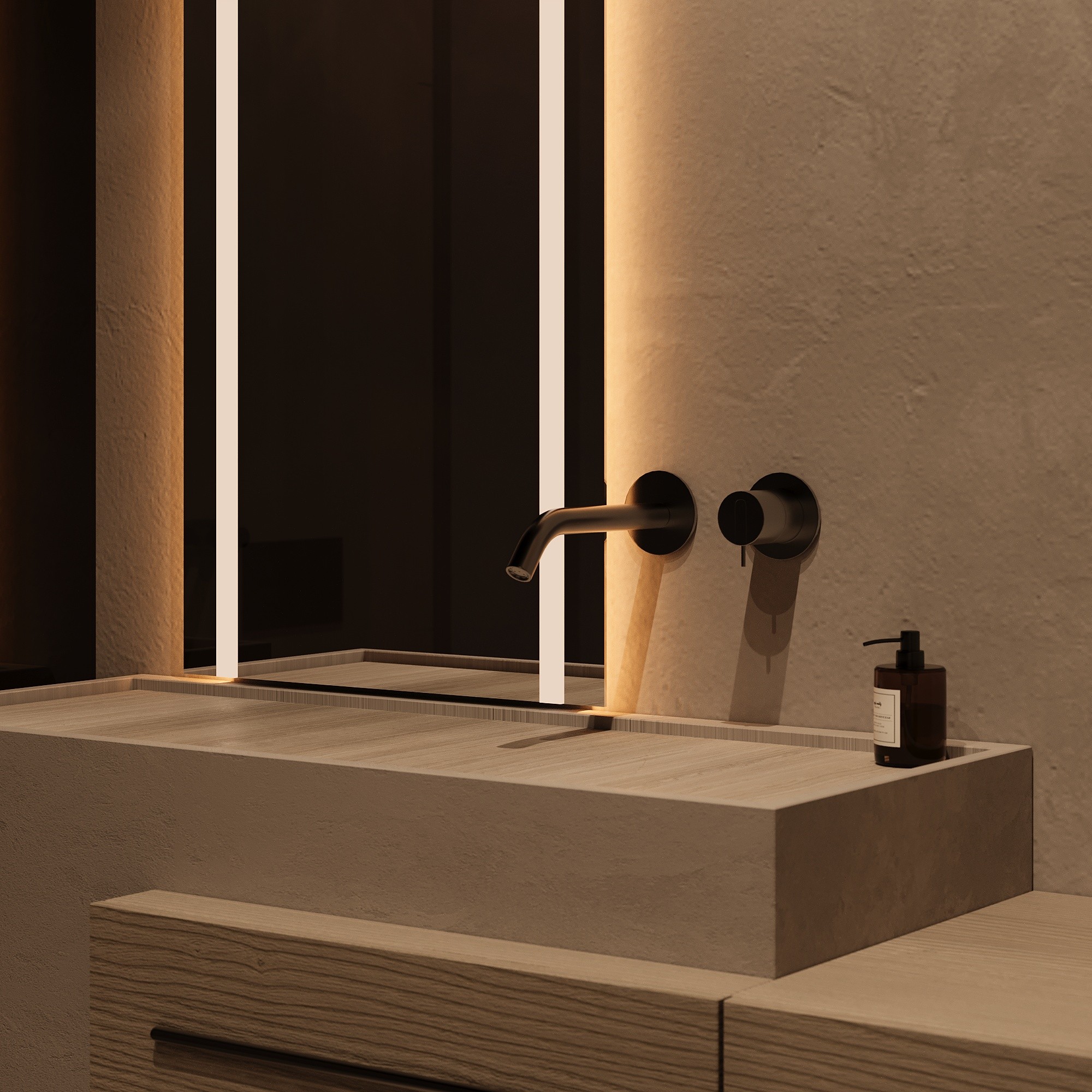
The most flattering vanity light comes from the sides. A pair of sconces flanking the mirror, centered at roughly 60 to 66 inches above the floor and spaced about 30 to 36 inches apart, light the face evenly from both directions and minimize shadows. Diffused shades of opal glass, fabric or frosted acrylic soften the light; bare bulbs and clear glass cause glare at eye level. Where sconces do not fit, for example on a wide double vanity or a mirror that runs wall to wall, there are alternatives. Vertical LED strips integrated into the mirror or recessed into the wall beside it work in the same way. A linear fixture above the mirror, mounted around 75 to 80 inches from the floor, is a reasonable second choice, ideally paired with a lighter source below, such as a backlit mirror or under-vanity glow, to fill shadows. For double vanities, give each basin its own pair of sources, or at least one on each side of each mirror. A magnifying makeup mirror with its own ring light covers precise tasks. Mirrors with integrated demisting pads keep the glass clear after a shower and are worth the small additional wiring.
The most flattering vanity light comes from the sides. A pair of sconces flanking the mirror, centered at roughly 60 to 66 inches above the floor and spaced about 30 to 36 inches apart, light the face evenly from both directions and minimize shadows. Diffused shades of opal glass, fabric or frosted acrylic soften the light; bare bulbs and clear glass cause glare at eye level. Where sconces do not fit, for example on a wide double vanity or a mirror that runs wall to wall, there are alternatives. Vertical LED strips integrated into the mirror or recessed into the wall beside it work in the same way. A linear fixture above the mirror, mounted around 75 to 80 inches from the floor, is a reasonable second choice, ideally paired with a lighter source below, such as a backlit mirror or under-vanity glow, to fill shadows. For double vanities, give each basin its own pair of sources, or at least one on each side of each mirror. A magnifying makeup mirror with its own ring light covers precise tasks. Mirrors with integrated demisting pads keep the glass clear after a shower and are worth the small additional wiring.
03
03
Ambient and accent layers
Ambient light fills the room so it does not feel like a stage around the mirror. In a small bathroom, a single ceiling fixture with a diffuser or two well-placed downlights may be enough. In larger primary baths, a cove of indirect LED along the ceiling perimeter or a recessed slot in plaster gives soft, shadowless light that makes the ceiling appear higher. Downlights should have deep, glare-reducing optics and be positioned over circulation rather than directly over the vanity or the tub, where they would shine into the eyes of someone lying back. Accent light gives the room depth. A wall-washing fixture across a stone feature wall reveals veining and texture. Linear LED in a shower niche lights shampoo bottles and stone without a visible source. A grazing light beside a freestanding tub, or a decorative pendant hung safely clear of the tub zone, creates a focal point for evening baths. Under-vanity and toe-kick lighting does double duty. It makes a floating vanity appear to hover and provides the base for a night light layer. Keep accent sources fewer than you think you need; three or four well-placed effects read as considered, while a dozen read as a showroom.
Ambient light fills the room so it does not feel like a stage around the mirror. In a small bathroom, a single ceiling fixture with a diffuser or two well-placed downlights may be enough. In larger primary baths, a cove of indirect LED along the ceiling perimeter or a recessed slot in plaster gives soft, shadowless light that makes the ceiling appear higher. Downlights should have deep, glare-reducing optics and be positioned over circulation rather than directly over the vanity or the tub, where they would shine into the eyes of someone lying back. Accent light gives the room depth. A wall-washing fixture across a stone feature wall reveals veining and texture. Linear LED in a shower niche lights shampoo bottles and stone without a visible source. A grazing light beside a freestanding tub, or a decorative pendant hung safely clear of the tub zone, creates a focal point for evening baths. Under-vanity and toe-kick lighting does double duty. It makes a floating vanity appear to hover and provides the base for a night light layer. Keep accent sources fewer than you think you need; three or four well-placed effects read as considered, while a dozen read as a showroom.
04
04
Color temperature and color rendering
Color temperature sets the mood; color rendering sets the accuracy. For most bathrooms, 2700K to 3000K suits the room as a whole, producing a warm, comfortable light that flatters skin and natural stone. Some clients prefer a slightly cooler 3000K to 3500K at the vanity for morning tasks, which is fine if the rest of the room stays warm. Mixing color temperatures carelessly, such as a cool 4000K vanity beside warm 2700K downlights, makes the room feel disjointed and skin tones inconsistent. Color rendering index, or CRI, describes how faithfully a light source shows colors compared with daylight. For a vanity, choose fixtures with a CRI of 90 or higher. The R9 value, which measures saturated red rendering, matters for skin tones in particular; a strong R9 makes faces look healthy rather than gray. Tunable white fixtures, which shift color temperature through the day, are increasingly available and can make sense in a primary bath: cooler and brighter in the morning, warmer and dimmer at night. Dim-to-warm fixtures offer a simpler version, moving toward a candle-like amber as they dim. Either should be specified with drivers and controls that are known to work together, to avoid flicker.
Color temperature sets the mood; color rendering sets the accuracy. For most bathrooms, 2700K to 3000K suits the room as a whole, producing a warm, comfortable light that flatters skin and natural stone. Some clients prefer a slightly cooler 3000K to 3500K at the vanity for morning tasks, which is fine if the rest of the room stays warm. Mixing color temperatures carelessly, such as a cool 4000K vanity beside warm 2700K downlights, makes the room feel disjointed and skin tones inconsistent. Color rendering index, or CRI, describes how faithfully a light source shows colors compared with daylight. For a vanity, choose fixtures with a CRI of 90 or higher. The R9 value, which measures saturated red rendering, matters for skin tones in particular; a strong R9 makes faces look healthy rather than gray. Tunable white fixtures, which shift color temperature through the day, are increasingly available and can make sense in a primary bath: cooler and brighter in the morning, warmer and dimmer at night. Dim-to-warm fixtures offer a simpler version, moving toward a candle-like amber as they dim. Either should be specified with drivers and controls that are known to work together, to avoid flicker.
05
05
Wet locations, dimming and night light
Safety rules shape where fixtures can go. In the United States, fixtures in a shower or directly exposed to water must be listed for wet locations, and those in the general bathroom should be at least damp-rated. The National Electrical Code also restricts hanging fixtures, pendants and track lighting within a defined zone around the tub and shower, roughly three feet horizontally and eight feet vertically from the tub rim or shower threshold. A licensed electrician confirms compliance with local code. Fixtures specified under European IP ratings, such as IP44 or IP65, still need the appropriate US listing. Every layer should be on its own circuit and dimmable, with LED drivers and dimmers chosen as a compatible pair. Simple scene controls, such as morning, evening and night, save clients from managing several switches with wet hands. Night light deserves its own design. A low-level toe-kick strip or step lights near the floor, at a very warm 2200K or amber and low output, let someone find the way without the bright overhead light that disrupts sleep. Motion sensors with a gentle fade-on, limited to night hours, make the system work without anyone touching a switch.
Safety rules shape where fixtures can go. In the United States, fixtures in a shower or directly exposed to water must be listed for wet locations, and those in the general bathroom should be at least damp-rated. The National Electrical Code also restricts hanging fixtures, pendants and track lighting within a defined zone around the tub and shower, roughly three feet horizontally and eight feet vertically from the tub rim or shower threshold. A licensed electrician confirms compliance with local code. Fixtures specified under European IP ratings, such as IP44 or IP65, still need the appropriate US listing. Every layer should be on its own circuit and dimmable, with LED drivers and dimmers chosen as a compatible pair. Simple scene controls, such as morning, evening and night, save clients from managing several switches with wet hands. Night light deserves its own design. A low-level toe-kick strip or step lights near the floor, at a very warm 2200K or amber and low output, let someone find the way without the bright overhead light that disrupts sleep. Motion sensors with a gentle fade-on, limited to night hours, make the system work without anyone touching a switch.
06
06
How we plan bathroom lighting
We design lighting at the same time as the layout, not after the tile is chosen. Sconce positions depend on mirror width, basin spacing and tile joints; a cove depends on ceiling construction; niche lighting depends on waterproofing details. Resolving all of it together on drawings avoids the familiar compromise of a sconce landing on a grout line or a downlight shining straight into the bath. Our bathrooms range from the green-arch family bathroom in the Layered Contrasts Residence in New York to the travertine baths of the Sculptural Duplex in Manhattan, and in each the approach is the same: light the face well, keep the room warm and calm, and add accents sparingly. Every bathroom is shown in photorealistic 3D renders before ordering, so clients can judge the balance of light on stone and skin rather than imagine it. Fixtures are purchased at cost with every supplier invoice visible, under one fixed design fee agreed before work begins. We coordinate with licensed electricians on circuits, ratings and controls, and supervise installation until handover. The result should be a bathroom that is accurate at seven in the morning and restful at eleven at night.
We design lighting at the same time as the layout, not after the tile is chosen. Sconce positions depend on mirror width, basin spacing and tile joints; a cove depends on ceiling construction; niche lighting depends on waterproofing details. Resolving all of it together on drawings avoids the familiar compromise of a sconce landing on a grout line or a downlight shining straight into the bath. Our bathrooms range from the green-arch family bathroom in the Layered Contrasts Residence in New York to the travertine baths of the Sculptural Duplex in Manhattan, and in each the approach is the same: light the face well, keep the room warm and calm, and add accents sparingly. Every bathroom is shown in photorealistic 3D renders before ordering, so clients can judge the balance of light on stone and skin rather than imagine it. Fixtures are purchased at cost with every supplier invoice visible, under one fixed design fee agreed before work begins. We coordinate with licensed electricians on circuits, ratings and controls, and supervise installation until handover. The result should be a bathroom that is accurate at seven in the morning and restful at eleven at night.
Questions
How high should vanity sconces be mounted?
–
Mount vanity sconces so their center sits at roughly 60 to 66 inches above the finished floor, close to face height for most adults. Space them about 30 to 36 inches apart on either side of the mirror. This places even light across the face and avoids the shadows created by downlights mounted directly above the vanity.
What color temperature is right for a bathroom?
+
Warm white between 2700K and 3000K suits most bathrooms, flattering skin and natural stone. Some people prefer up to 3500K at the vanity for morning tasks. Choose fixtures with a color rendering index of 90 or above, and a good R9 value, so skin tones and makeup look natural and accurate in the mirror.
Can you hang a pendant or chandelier over a bathtub?
+
In the United States, the National Electrical Code restricts hanging fixtures within a zone of about three feet horizontally and eight feet vertically from the tub rim or shower threshold. A pendant must hang outside that zone or be replaced by a suitably listed fixture. A licensed electrician should confirm placement against the code adopted locally.
What is the right night light for a bathroom?
+
A low-level light near the floor, such as a toe-kick strip under the vanity or a few step lights, works well. Use a very warm color around 2200K or amber, at low brightness, ideally on a motion sensor limited to night hours. It allows safe movement without the bright overhead light that disrupts sleep.
M.V
Marian Vist
Principal designer, ImPERFECTION DESIGN. Creates the design concept and leads the decisions that shape each home. New York · New Jersey · Florida · International.
Meet Marian
Continue reading
All articles

Take the idea into your own home.
Tell us which subject connects with your plans and the decision you would like to explore.
Tell us which subject connects with your plans and the decision you would like to explore.