Free discovery call with our principal designer.
✕
Free discovery call with our principal designer.
✕

Custom Bedroom Millwork and Built-Ins Worth Investing In
Which bedroom built-ins earn their cost: headboard walls, wardrobes, window seats and desk niches, plus integrated lighting, wood species and finishes.
Which bedroom built-ins earn their cost: headboard walls, wardrobes, window seats and desk niches, plus integrated lighting, wood species and finishes.
Which bedroom built-ins earn their cost: headboard walls, wardrobes, window seats and desk niches, plus integrated lighting, wood species and finishes.
M.V
Marian Vist · Principal designer
·
·
5 min read

Take this into your home
Bring this article into your first conversation.
Share the passage and explain how it relates to the home you are planning.
01
01
Which Bedroom Built-Ins Are Worth It
The bedroom built-ins worth investing in are the ones you use every day and that solve a problem freestanding furniture cannot: a wardrobe wall that fits the room exactly, a headboard wall that integrates lighting and switches, and a window seat or desk niche that turns awkward space into a useful place. Decorative paneling for its own sake comes second. Custom millwork costs more than freestanding pieces and cannot move house with you, so it should earn its place. The test we apply is simple. Does it use space that would otherwise be wasted, such as a niche beside a chimney breast, the depth under a window or the full height of a wall? Does it integrate services, like lighting, power and controls, that would otherwise be visible? Does it give the room proportions or architecture it lacks? When the answer is yes, built-ins make a bedroom calmer by reducing loose furniture and visible clutter. When the answer is no, a beautiful freestanding wardrobe or a pair of antique chests may serve better and carry more character, and they can follow you to the next home. The pieces below are the ones that most often pass the test.
The bedroom built-ins worth investing in are the ones you use every day and that solve a problem freestanding furniture cannot: a wardrobe wall that fits the room exactly, a headboard wall that integrates lighting and switches, and a window seat or desk niche that turns awkward space into a useful place. Decorative paneling for its own sake comes second. Custom millwork costs more than freestanding pieces and cannot move house with you, so it should earn its place. The test we apply is simple. Does it use space that would otherwise be wasted, such as a niche beside a chimney breast, the depth under a window or the full height of a wall? Does it integrate services, like lighting, power and controls, that would otherwise be visible? Does it give the room proportions or architecture it lacks? When the answer is yes, built-ins make a bedroom calmer by reducing loose furniture and visible clutter. When the answer is no, a beautiful freestanding wardrobe or a pair of antique chests may serve better and carry more character, and they can follow you to the next home. The pieces below are the ones that most often pass the test.
02
02
Headboard Walls and Wardrobes
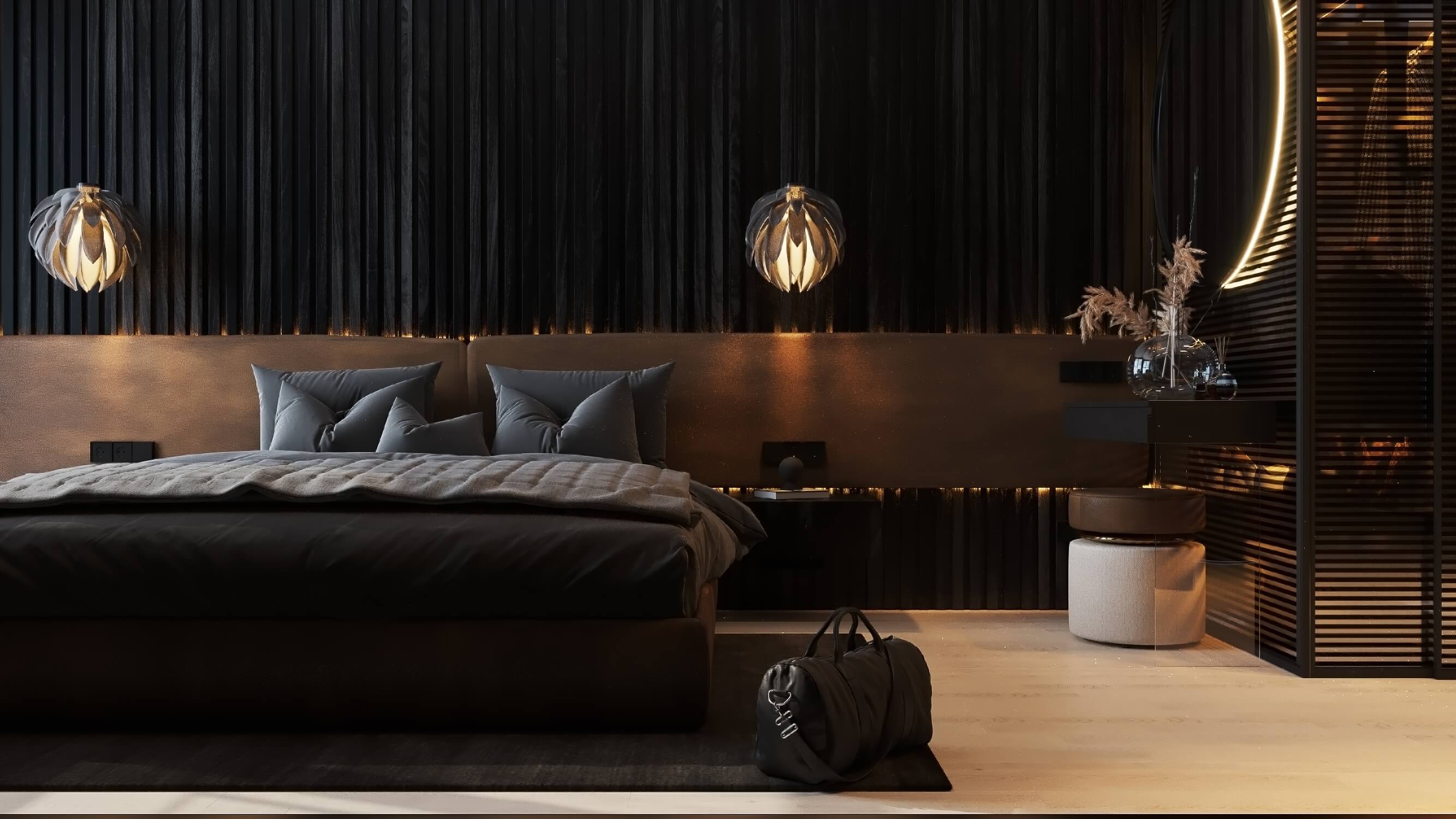
A headboard wall extends the bed's backdrop across the full width of the bed and nightstands, sometimes to the ceiling. It can be upholstered panels, wood paneling, fabric-wrapped acoustic panels or a combination. It hides wiring for reading lights, outlets, USB-C points and switches, and it can carry floating nightstands so the floor stays clear. In rooms with low or awkward ceilings, it gives the bed a strong architecture. Wardrobes are the most practical built-in. An internal depth of about 24 inches lets hangers sit across the rod; shallower depths need pull-out rails. Plan the interior from your inventory: double hanging sections at about 40 inches each, long hanging at 60 to 66 inches, shelves and drawers for folded items. Full-height doors, without a gap at the ceiling, keep out dust and look more architectural. Hinged doors give full access but need clearance in front, roughly the width of a door plus room to stand. Sliding doors save space but open only half the wardrobe at a time, and pocket doors that slide back into the carcass can offer full access in some configurations. Glass-fronted wardrobes, as in the bedroom suites of the Warm Modernism Residence in the Chicago suburbs, Illinois, show clothes while protecting them from dust.
A headboard wall extends the bed's backdrop across the full width of the bed and nightstands, sometimes to the ceiling. It can be upholstered panels, wood paneling, fabric-wrapped acoustic panels or a combination. It hides wiring for reading lights, outlets, USB-C points and switches, and it can carry floating nightstands so the floor stays clear. In rooms with low or awkward ceilings, it gives the bed a strong architecture. Wardrobes are the most practical built-in. An internal depth of about 24 inches lets hangers sit across the rod; shallower depths need pull-out rails. Plan the interior from your inventory: double hanging sections at about 40 inches each, long hanging at 60 to 66 inches, shelves and drawers for folded items. Full-height doors, without a gap at the ceiling, keep out dust and look more architectural. Hinged doors give full access but need clearance in front, roughly the width of a door plus room to stand. Sliding doors save space but open only half the wardrobe at a time, and pocket doors that slide back into the carcass can offer full access in some configurations. Glass-fronted wardrobes, as in the bedroom suites of the Warm Modernism Residence in the Chicago suburbs, Illinois, show clothes while protecting them from dust.
03
03
Window Seats and Desk Niches
A window seat turns a deep window or a bay into a place to read and adds storage below. A comfortable seat sits about 17 to 19 inches high including the cushion, and 18 to 24 inches deep; deeper seats invite lying down but need more cushions for sitting upright. Drawers below are easier to use than lift-up lids, which require removing the cushion each time. In older New York and New Jersey homes, windows often sit above radiators. A window seat can enclose the radiator if the front includes an adequate grille and the seat lets heat rise, typically through a slotted or perforated section near the glass. Cushions should be removable for cleaning and covered in performance fabric if the window gets direct sun. A desk niche suits a bedroom that must occasionally serve as an office. A writing surface 29 to 30 inches high and at least 20 to 24 inches deep, with integrated cable management, a task light and a closed cabinet above, or doors that close over the whole niche, lets work disappear at the end of the day. Where sleep matters, being able to close the desk away is worth the extra hinges.
A window seat turns a deep window or a bay into a place to read and adds storage below. A comfortable seat sits about 17 to 19 inches high including the cushion, and 18 to 24 inches deep; deeper seats invite lying down but need more cushions for sitting upright. Drawers below are easier to use than lift-up lids, which require removing the cushion each time. In older New York and New Jersey homes, windows often sit above radiators. A window seat can enclose the radiator if the front includes an adequate grille and the seat lets heat rise, typically through a slotted or perforated section near the glass. Cushions should be removable for cleaning and covered in performance fabric if the window gets direct sun. A desk niche suits a bedroom that must occasionally serve as an office. A writing surface 29 to 30 inches high and at least 20 to 24 inches deep, with integrated cable management, a task light and a closed cabinet above, or doors that close over the whole niche, lets work disappear at the end of the day. Where sleep matters, being able to close the desk away is worth the extra hinges.
04
04
Integrated Lighting and Hardware
Lighting built into millwork transforms it. LED strips set into an aluminum channel with a diffuser give continuous light without visible dots. Inside wardrobes, lighting can be integrated into rods, shelves or the sides of openings and switched by door sensors. Behind a headboard wall, an indirect strip creates a soft glow for evenings. Two details make integrated lighting durable. First, drivers (the power supplies for the LEDs) must be accessible, typically behind a removable panel or in a nearby cabinet, because they will eventually need replacing. Second, the color temperature and CRI of millwork lighting should match the room's other fixtures, otherwise a wardrobe may look cold beside warm lamps. Hardware deserves the same care as the wood. Soft-close hinges and full-extension drawer slides are standard for quality millwork. Push-to-open mechanisms suit handleless designs but can be triggered accidentally on lower drawers. Pulls in leather, bronze or solid brass age well and give the hand something to hold. Choose the finish of pulls and hinges together with the room's light fixtures and door hardware, so the metals relate rather than compete.
Lighting built into millwork transforms it. LED strips set into an aluminum channel with a diffuser give continuous light without visible dots. Inside wardrobes, lighting can be integrated into rods, shelves or the sides of openings and switched by door sensors. Behind a headboard wall, an indirect strip creates a soft glow for evenings. Two details make integrated lighting durable. First, drivers (the power supplies for the LEDs) must be accessible, typically behind a removable panel or in a nearby cabinet, because they will eventually need replacing. Second, the color temperature and CRI of millwork lighting should match the room's other fixtures, otherwise a wardrobe may look cold beside warm lamps. Hardware deserves the same care as the wood. Soft-close hinges and full-extension drawer slides are standard for quality millwork. Push-to-open mechanisms suit handleless designs but can be triggered accidentally on lower drawers. Pulls in leather, bronze or solid brass age well and give the hand something to hold. Choose the finish of pulls and hinges together with the room's light fixtures and door hardware, so the metals relate rather than compete.
05
05
Wood Species and Finishes
White oak is the most versatile choice: stable, durable and receptive to many finishes, from pale and natural to fumed or darkened. Rift-sawn oak shows a straight, quiet grain; quarter-sawn oak adds a ray fleck pattern. Walnut is warmer and richer, and at its strongest in darker rooms. Ash has a lively grain and takes stain well. For painted millwork, a stable substrate such as MDF or high-quality plywood under a sprayed lacquer gives a smooth, durable surface. Most large panels are made with veneer on a stable core rather than solid wood, which moves with humidity. Veneer can be book-matched, slip-matched or sequenced across doors so the grain flows along a whole wall, something solid boards cannot achieve. Finishes protect the wood and define the look. Catalyzed lacquers and conversion varnishes are durable and easy to clean. Oil and hardwax finishes feel more natural and can be spot-repaired, but need periodic maintenance. In Florida's humidity, every face of a panel should be sealed, and millwork should acclimate on site before installation. The Charcoal English Study in New Jersey, a home office and library with charcoal millwork, shows how much a single millwork color can define a room.
White oak is the most versatile choice: stable, durable and receptive to many finishes, from pale and natural to fumed or darkened. Rift-sawn oak shows a straight, quiet grain; quarter-sawn oak adds a ray fleck pattern. Walnut is warmer and richer, and at its strongest in darker rooms. Ash has a lively grain and takes stain well. For painted millwork, a stable substrate such as MDF or high-quality plywood under a sprayed lacquer gives a smooth, durable surface. Most large panels are made with veneer on a stable core rather than solid wood, which moves with humidity. Veneer can be book-matched, slip-matched or sequenced across doors so the grain flows along a whole wall, something solid boards cannot achieve. Finishes protect the wood and define the look. Catalyzed lacquers and conversion varnishes are durable and easy to clean. Oil and hardwax finishes feel more natural and can be spot-repaired, but need periodic maintenance. In Florida's humidity, every face of a panel should be sealed, and millwork should acclimate on site before installation. The Charcoal English Study in New Jersey, a home office and library with charcoal millwork, shows how much a single millwork color can define a room.
06
06
How We Design and Build Millwork
ImPERFECTION DESIGN draws millwork in plan, elevation and section, showing internal fittings, lighting, hardware and the grain direction of veneers. Every room is rendered in photorealistic 3D before production, and we refine the drawings with you in as many rounds as needed within the design stage. Millwork is built by specialist workshops from our network of 150+ suppliers and workrooms and purchased at cost with 0% markup, with each invoice visible to you. Custom pieces often need several months from approved drawings to installation, including shop drawings, samples and finishing, so we schedule them early and track them in weekly progress updates. It is always worth approving finish samples in the room's own light before production begins, because color and sheen read differently in every space. Deliveries are inspected before installation, and the boutique studio supervises the site until handover. Good built-ins should look as though they arrived with the house. That is the standard we work toward, room by room and drawer by drawer.
ImPERFECTION DESIGN draws millwork in plan, elevation and section, showing internal fittings, lighting, hardware and the grain direction of veneers. Every room is rendered in photorealistic 3D before production, and we refine the drawings with you in as many rounds as needed within the design stage. Millwork is built by specialist workshops from our network of 150+ suppliers and workrooms and purchased at cost with 0% markup, with each invoice visible to you. Custom pieces often need several months from approved drawings to installation, including shop drawings, samples and finishing, so we schedule them early and track them in weekly progress updates. It is always worth approving finish samples in the room's own light before production begins, because color and sheen read differently in every space. Deliveries are inspected before installation, and the boutique studio supervises the site until handover. Good built-ins should look as though they arrived with the house. That is the standard we work toward, room by room and drawer by drawer.
Questions
How deep should a built-in wardrobe be?
–
A built-in wardrobe for hanging clothes needs an internal depth of about 24 inches so hangers sit across the rod without touching the doors. Shallower wardrobes, around 14 to 18 inches, can work with pull-out hanging rails or shelves for folded items. Add the thickness of doors and back panel to calculate the overall depth.
Is custom millwork worth it in a bedroom?
+
Custom millwork is worth it when it uses space that would otherwise be wasted, integrates lighting and power cleanly or gives the room architecture it lacks. A wardrobe wall, headboard wall or window seat often qualifies. For pieces that do not solve a specific problem, a well-made freestanding piece may offer more flexibility and character.
What wood species work well for bedroom built-ins?
+
White oak is the most versatile: stable and available in many tones, with rift-sawn oak giving a calm, straight grain. Walnut adds warmth and depth. Ash takes stain well. For painted millwork, MDF or quality plywood with a sprayed lacquer gives a smooth, durable finish that resists movement better than solid wood.
How long does custom bedroom millwork take?
+
Custom millwork often takes several months from approved design to installation. That time covers shop drawings, material and finish samples, fabrication, finishing and delivery. Lead times vary with the workroom, the complexity of the pieces and the finish. Planning millwork early in a renovation keeps it from delaying the rest of the project.
M.V
Marian Vist
Principal designer, ImPERFECTION DESIGN. Creates the design concept and leads the decisions that shape each home. New York · New Jersey · Florida · International.
Meet Marian
Continue reading
All articles

Take the idea into your own home.
Tell us which subject connects with your plans and the decision you would like to explore.
Tell us which subject connects with your plans and the decision you would like to explore.