Free discovery call with our principal designer.
✕
Free discovery call with our principal designer.
✕

Transitional vs Contemporary Kitchen Design: How to Choose
Transitional or contemporary kitchen? How door profiles, hardware, materials and lighting differ, how each style ages, and when a hybrid makes sense.
Transitional or contemporary kitchen? How door profiles, hardware, materials and lighting differ, how each style ages, and when a hybrid makes sense.
Transitional or contemporary kitchen? How door profiles, hardware, materials and lighting differ, how each style ages, and when a hybrid makes sense.
M.V
Marian Vist · Principal designer
·
·
5 min read
Take this into your home
Bring this article into your first conversation.
Share the passage and explain how it relates to the home you are planning.
01
01
The short answer: let the house and your habits decide
Choose a transitional kitchen if your house has classical bones, you like visible craftsmanship and you are comfortable with materials that patinate. Choose a contemporary kitchen if the architecture is modern, you prefer clear surfaces and you value precision over ornament. Most good kitchens lean one way while borrowing carefully from the other. The question usually arrives as a matter of taste, but architecture should have the first vote. A kitchen in a prewar apartment with plaster moldings, or in a Westchester or New Jersey house with paneled rooms, will look most settled when its cabinetry speaks the same language as the doors and trim around it. A kitchen in a glass-walled new build or a high-rise apartment can carry flat planes and minimal detail without fighting the envelope. Habits get the second vote. Contemporary kitchens reward households that put things away, because their beauty depends on uninterrupted surfaces. Transitional kitchens tolerate a little more life on display: a bowl of lemons, a row of copper pans, a cookbook open on a stand. Neither is more luxurious. The difference lies in what kind of order you find restful, and the right answer is the one you will still enjoy keeping in ten years.
Choose a transitional kitchen if your house has classical bones, you like visible craftsmanship and you are comfortable with materials that patinate. Choose a contemporary kitchen if the architecture is modern, you prefer clear surfaces and you value precision over ornament. Most good kitchens lean one way while borrowing carefully from the other. The question usually arrives as a matter of taste, but architecture should have the first vote. A kitchen in a prewar apartment with plaster moldings, or in a Westchester or New Jersey house with paneled rooms, will look most settled when its cabinetry speaks the same language as the doors and trim around it. A kitchen in a glass-walled new build or a high-rise apartment can carry flat planes and minimal detail without fighting the envelope. Habits get the second vote. Contemporary kitchens reward households that put things away, because their beauty depends on uninterrupted surfaces. Transitional kitchens tolerate a little more life on display: a bowl of lemons, a row of copper pans, a cookbook open on a stand. Neither is more luxurious. The difference lies in what kind of order you find restful, and the right answer is the one you will still enjoy keeping in ten years.
02
02
What transitional and contemporary actually mean
Transitional design takes traditional proportions and materials and simplifies their detail. A transitional kitchen keeps the logic of a classical room, with framed doors, a sense of base, body and cornice, and furniture-like pieces such as a hutch or a range alcove, but strips away heavy carving, applied ornament and fussy moldings. Painted or warm wood cabinetry, honed marble and unlacquered or aged brass are typical, along with paneled appliances so equipment does not interrupt the architecture. Contemporary design starts from the opposite direction. It treats the kitchen as a set of planes and volumes: flat doors, long horizontal lines, materials that run continuously, and hardware reduced or removed. Surfaces such as lacquer, wood veneer with matched grain, large-format porcelain, stainless steel and thick stone slabs carry the design. Proportion and alignment take the place of ornament. It helps to separate contemporary from modern. Modern usually refers to a historical movement: early and mid-twentieth-century design with its own vocabulary. Contemporary simply means what is being designed now, and it changes over time. Today it tends toward warm minimalism, with natural woods and honed stone replacing the high-gloss white that defined contemporary kitchens a decade or so ago.
Transitional design takes traditional proportions and materials and simplifies their detail. A transitional kitchen keeps the logic of a classical room, with framed doors, a sense of base, body and cornice, and furniture-like pieces such as a hutch or a range alcove, but strips away heavy carving, applied ornament and fussy moldings. Painted or warm wood cabinetry, honed marble and unlacquered or aged brass are typical, along with paneled appliances so equipment does not interrupt the architecture. Contemporary design starts from the opposite direction. It treats the kitchen as a set of planes and volumes: flat doors, long horizontal lines, materials that run continuously, and hardware reduced or removed. Surfaces such as lacquer, wood veneer with matched grain, large-format porcelain, stainless steel and thick stone slabs carry the design. Proportion and alignment take the place of ornament. It helps to separate contemporary from modern. Modern usually refers to a historical movement: early and mid-twentieth-century design with its own vocabulary. Contemporary simply means what is being designed now, and it changes over time. Today it tends toward warm minimalism, with natural woods and honed stone replacing the high-gloss white that defined contemporary kitchens a decade or so ago.
03
03
Door profiles and hardware
Doors are where the choice becomes visible. Transitional kitchens usually use a five-piece door: a frame of rails and stiles around a recessed center panel. The classic shaker profile has wide rails, around three inches, while a slim shaker narrows them to an inch or so and reads noticeably more current. Inset construction, where the door sits flush within a face frame, adds a furniture quality; a small bead on the frame pushes it further toward tradition. Contemporary kitchens use slab doors, a single flat panel, often with tight reveals of two to three millimeters between them. Handles are integrated or hidden: a recessed channel routed along the upper edge of the base cabinets, a finger pull cut into the door edge, or push-to-open mechanisms. The goal is a wall that reads as one surface. Hardware should follow the door. Transitional kitchens suit knobs, cup pulls and bar pulls in brass, nickel or bronze, chosen at a scale that feels good in the hand. Contemporary kitchens use slim edge pulls, long continuous rails or nothing at all. Fluted and reeded doors sit in between: their rhythm feels traditional, while their crisp execution can sit comfortably in a minimal room.
Doors are where the choice becomes visible. Transitional kitchens usually use a five-piece door: a frame of rails and stiles around a recessed center panel. The classic shaker profile has wide rails, around three inches, while a slim shaker narrows them to an inch or so and reads noticeably more current. Inset construction, where the door sits flush within a face frame, adds a furniture quality; a small bead on the frame pushes it further toward tradition. Contemporary kitchens use slab doors, a single flat panel, often with tight reveals of two to three millimeters between them. Handles are integrated or hidden: a recessed channel routed along the upper edge of the base cabinets, a finger pull cut into the door edge, or push-to-open mechanisms. The goal is a wall that reads as one surface. Hardware should follow the door. Transitional kitchens suit knobs, cup pulls and bar pulls in brass, nickel or bronze, chosen at a scale that feels good in the hand. Contemporary kitchens use slim edge pulls, long continuous rails or nothing at all. Fluted and reeded doors sit in between: their rhythm feels traditional, while their crisp execution can sit comfortably in a minimal room.
04
04
Materials and lighting for each style
In a transitional kitchen, materials tend toward the familiar and tactile. Honed Carrara or Calacatta marble, painted cabinetry in soft whites, greens or putty tones, rift or quartersawn oak, zellige or handmade tile backsplashes and wide plank wood floors all belong. Metals are warm and allowed to age. The range often sits in a plastered or stone-clad hood alcove, which becomes the focal point of the room. In a contemporary kitchen, materials are chosen for continuity. The same quartzite may run from counter to backsplash to the side of the island in a single waterfall. Veneers are book-matched or sequence-matched across a full wall. Dark stained oak, walnut, lacquer in deep or neutral tones, honed black granite and stainless steel are common, often with only two or three materials in the entire room. Lighting follows the same logic. Transitional rooms suit pendants with visible form, such as glass or metal shades over the island, and wall sconces flanking a window or open shelf. Contemporary rooms rely on concealed sources: recessed downlights with deep baffles, linear LED integrated into shelves and toe kicks, and perhaps one sculptural pendant as the single decorative gesture.
In a transitional kitchen, materials tend toward the familiar and tactile. Honed Carrara or Calacatta marble, painted cabinetry in soft whites, greens or putty tones, rift or quartersawn oak, zellige or handmade tile backsplashes and wide plank wood floors all belong. Metals are warm and allowed to age. The range often sits in a plastered or stone-clad hood alcove, which becomes the focal point of the room. In a contemporary kitchen, materials are chosen for continuity. The same quartzite may run from counter to backsplash to the side of the island in a single waterfall. Veneers are book-matched or sequence-matched across a full wall. Dark stained oak, walnut, lacquer in deep or neutral tones, honed black granite and stainless steel are common, often with only two or three materials in the entire room. Lighting follows the same logic. Transitional rooms suit pendants with visible form, such as glass or metal shades over the island, and wall sconces flanking a window or open shelf. Contemporary rooms rely on concealed sources: recessed downlights with deep baffles, linear LED integrated into shelves and toe kicks, and perhaps one sculptural pendant as the single decorative gesture.
05
05
How each style ages, and the hybrid path
Transitional kitchens tend to age well because their references are already old. Paint can be refreshed, brass darkens gracefully and marble wears into a softer surface. The risk is dilution: when transitional becomes a default, with generic shaker doors, a gray quartz counter and stock hardware, it can look like a builder package rather than a considered room. Contemporary kitchens age according to the quality of their execution. Perfectly aligned slab doors, consistent reveals and hardwearing matte finishes can look as precise after fifteen years as on day one. Weak construction shows quickly, because a flat door that warps or a misaligned gap has no molding to hide behind. Trend-driven finishes, such as high-gloss lacquer in a fashionable color, tend to date fastest. Many of the kitchens we design sit deliberately between the two. A slim shaker or fluted door in rift white oak, integrated pulls instead of knobs, a classic veined marble on the island and concealed lighting is a combination that reads warm and current. Our boutique studio develops this territory through directions such as Warm Minimalism and Modern Heritage, where classical proportion and contemporary restraint support each other rather than compete.
Transitional kitchens tend to age well because their references are already old. Paint can be refreshed, brass darkens gracefully and marble wears into a softer surface. The risk is dilution: when transitional becomes a default, with generic shaker doors, a gray quartz counter and stock hardware, it can look like a builder package rather than a considered room. Contemporary kitchens age according to the quality of their execution. Perfectly aligned slab doors, consistent reveals and hardwearing matte finishes can look as precise after fifteen years as on day one. Weak construction shows quickly, because a flat door that warps or a misaligned gap has no molding to hide behind. Trend-driven finishes, such as high-gloss lacquer in a fashionable color, tend to date fastest. Many of the kitchens we design sit deliberately between the two. A slim shaker or fluted door in rift white oak, integrated pulls instead of knobs, a classic veined marble on the island and concealed lighting is a combination that reads warm and current. Our boutique studio develops this territory through directions such as Warm Minimalism and Modern Heritage, where classical proportion and contemporary restraint support each other rather than compete.
06
06
How we help clients choose
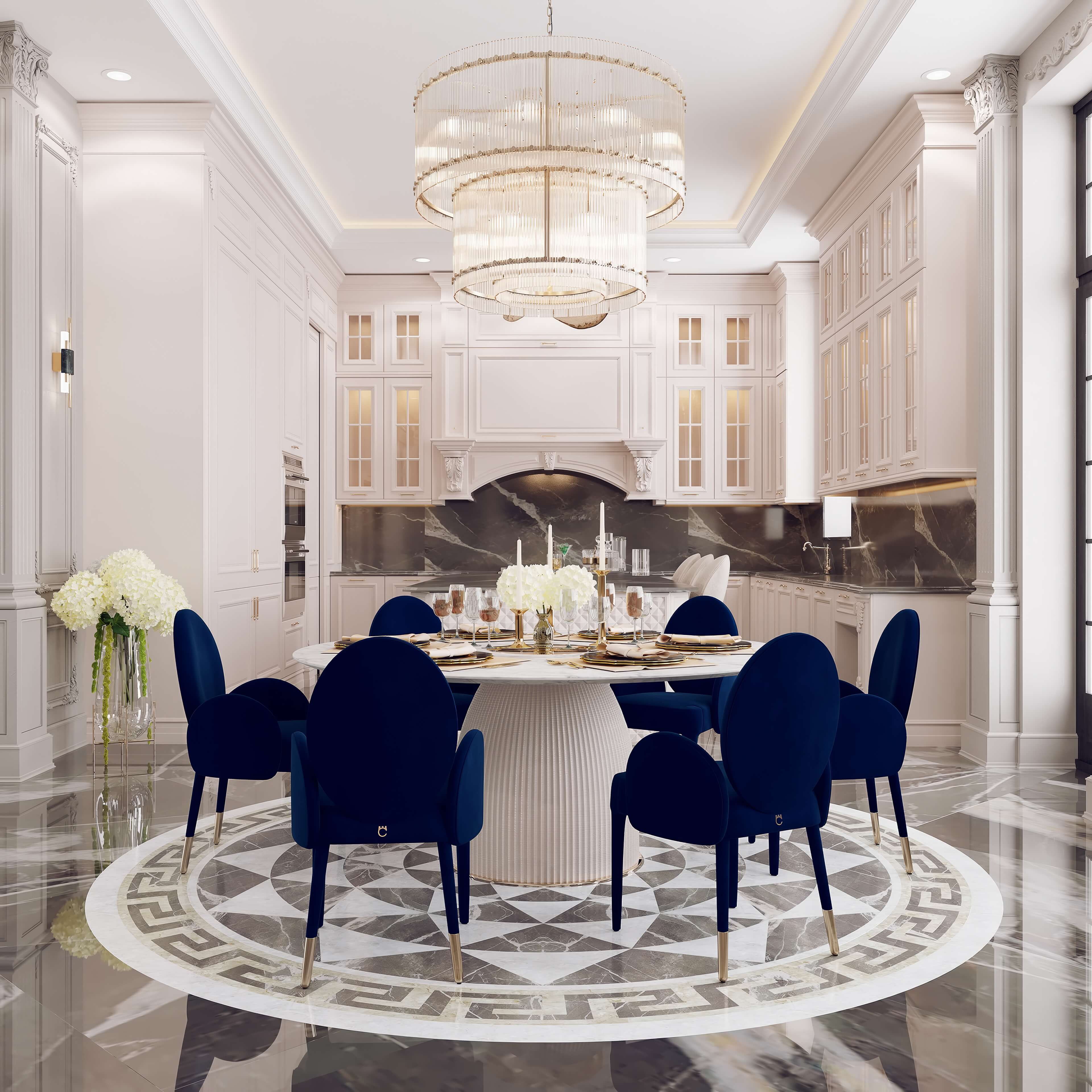
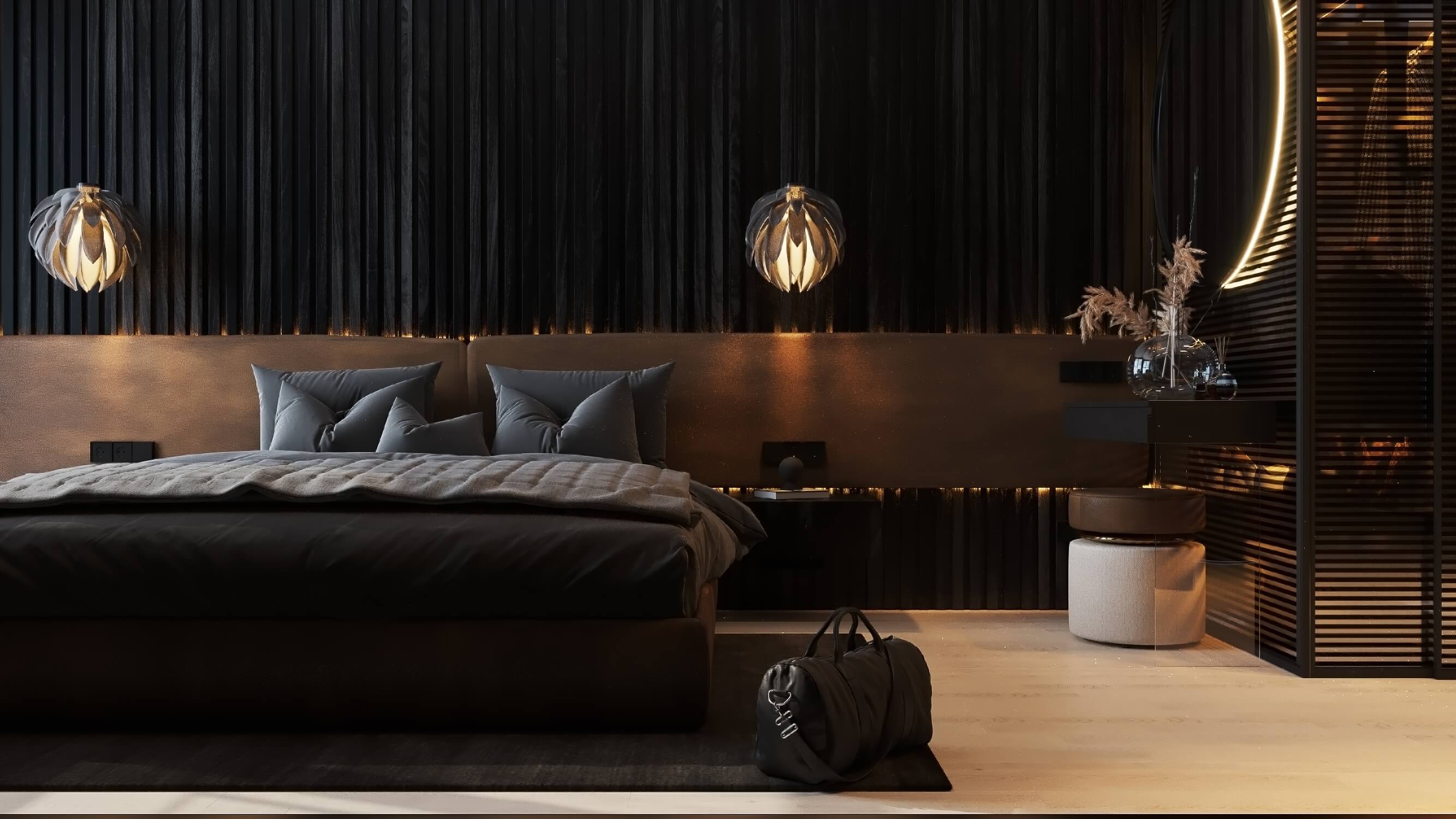
We rarely ask clients to pick a style label. Instead, we look at the architecture of the house, the rooms that open onto the kitchen and the images a client is drawn to, and we find what those images share: often a particular wood tone, a quality of light or a preference for visible craft. The design is derived from the client rather than from a house style we apply everywhere. Our own projects show the range. The Layered Contrasts Residence in New York combines classical paneling and veined marble with integrated technology, while the Dark Texture Residence, a New York high-rise apartment, works in walnut, raw black stone and warm metallic detail. Both are calm, and neither depends on a single label. Before anything is ordered, every option is shown in photorealistic 3D renders of the actual room, so the difference between a three inch and a one inch rail, or between a knob and an edge pull, can be judged in context. Clients comment in as many rounds as the design stage requires, and the decision is made with the whole house in view, under one fixed fee agreed at the outset.
We rarely ask clients to pick a style label. Instead, we look at the architecture of the house, the rooms that open onto the kitchen and the images a client is drawn to, and we find what those images share: often a particular wood tone, a quality of light or a preference for visible craft. The design is derived from the client rather than from a house style we apply everywhere. Our own projects show the range. The Layered Contrasts Residence in New York combines classical paneling and veined marble with integrated technology, while the Dark Texture Residence, a New York high-rise apartment, works in walnut, raw black stone and warm metallic detail. Both are calm, and neither depends on a single label. Before anything is ordered, every option is shown in photorealistic 3D renders of the actual room, so the difference between a three inch and a one inch rail, or between a knob and an edge pull, can be judged in context. Clients comment in as many rounds as the design stage requires, and the decision is made with the whole house in view, under one fixed fee agreed at the outset.
Questions
What is a transitional kitchen?
–
A transitional kitchen combines traditional proportions and materials with simplified detail. It typically uses framed shaker or inset doors, painted or warm wood cabinetry, honed marble, paneled appliances and brass or nickel hardware, but avoids heavy ornament and elaborate moldings. The result feels classic and familiar while remaining clean enough to sit comfortably in a modern household.
What is the difference between a contemporary and a modern kitchen?
+
Modern usually refers to a specific design movement of the early and mid-twentieth century, with its own forms and materials. Contemporary means design of the present moment, so its look changes over time. Today a contemporary kitchen usually means flat slab doors, hidden or integrated handles, continuous stone surfaces, warm wood veneers and concealed lighting.
Which kitchen style holds its value longer?
+
Both can last if they suit the architecture and are well built. Transitional kitchens draw on established references and age gracefully, but generic versions can look ordinary. Contemporary kitchens stay sharp when construction is precise and finishes are matte and durable, while trend-driven colors and high gloss tend to date faster than the cabinetry itself.
Can you mix transitional and contemporary elements in one kitchen?
+
Yes, and many well-designed kitchens do. A common hybrid pairs slim shaker or fluted doors in white oak with integrated pulls, a classic veined marble island and concealed linear lighting. The key is choosing one style as the base and borrowing a few elements deliberately, rather than splitting the room evenly between two languages.
M.V
Marian Vist
Principal designer, ImPERFECTION DESIGN. Creates the design concept and leads the decisions that shape each home. New York · New Jersey · Florida · International.
Meet Marian
Continue reading
All articles

Take the idea into your own home.
Tell us which subject connects with your plans and the decision you would like to explore.
Tell us which subject connects with your plans and the decision you would like to explore.